Analysis · Commercial feature · Technology · europe
SAMFCore vs Mambu: Two Different Approaches to Financial Technology — Which Offers Greater Long-Term Value?
An examination of functionality, architecture, licensing economics, deployment flexibility and technology independence — and why the differences matter for financial-services operators.

Executive Summary
Choosing financial-services software is no longer simply a question of identifying the platform with the most comprehensive feature list. For banks, electronic-money institutions, payment-service providers and digital-asset businesses, the decision increasingly concerns something more fundamental: which technology should form the foundation of their operations, how much control they should retain over it, and what that technology will ultimately cost to operate over many years.
Mambu and SAMFCore approach these questions from distinctly different directions.
Mambu is an established cloud-native core banking and payments technology provider. Its strengths lie in deposit and lending infrastructure, configurable financial products, accounting, payment processing and the integration capabilities required by institutions modernising banking operations. Its international customer base and established implementation ecosystem give it considerable credibility.
SAMFCore, developed and commercialised by Swiss AMF AG, is positioned differently. Rather than seeking to replace a bank's complete authoritative core banking ledger, it provides an integrated financial-services operating platform incorporating customer accounts, internal balance management, payments, card workflows, digital assets, foreign exchange, compliance functions and administration.
The distinction matters. Mambu is particularly relevant where the central requirement is sophisticated banking infrastructure. SAMFCore addresses the needs of operators seeking to deliver and administer multiple financial services through a unified software environment, typically alongside selected banking, payment, custody and other external providers.
There is also a significant difference in how the technology is supplied.
Mambu follows a managed software-as-a-service model with customer-specific enterprise contracts. SAMFCore offers published annual and perpetual licensing options, including packages providing Full Source Code, independent development rights and customer-controlled deployment.
Those commercial distinctions could be consequential for institutions planning to operate their financial technology over a five- or ten-year horizon.
The central finding of this comparison is that Mambu offers greater specialisation in conventional core banking, while SAMFCore presents a notably strong proposition for financial-services operators prioritising integrated functionality, licensing predictability and long-term control over their software.
For the right type of institution, SAMFCore's advantages may prove more commercially significant than the scale or market recognition of its larger competitor.
That conclusion requires some qualification. The products are not direct substitutes in every application, and their relative value must ultimately be established against a purchaser's specific operational requirements.
Nevertheless, the comparison reveals several areas in which SAMFCore merits considerably more attention than its relative market profile might suggest.
1. Understanding What Each Platform Actually Does
A useful comparison must begin with architecture rather than marketing terminology.
The expression financial technology platform can describe anything from a core ledger and lending engine to a customer application, payments orchestration system or integrated operating environment.
Mambu and SAMFCore occupy different positions within that landscape.
Mambu: A specialist banking and payments foundation
Mambu has built its reputation on configurable, cloud-native banking infrastructure.
Its core banking capabilities encompass deposits, savings products, lending, account servicing, interest calculations, transaction accounting and associated financial operations.
These capabilities are especially important to institutions that need to administer financial products at the level of the underlying banking system.
A lending institution, for example, may need detailed control over loan disbursements, repayment schedules, interest calculations, arrears and product configuration. A deposit-taking bank may require specialised accounting and account-servicing capabilities linked to its banking operations.
Mambu is specifically designed to address these requirements.
Its proposition has also expanded beyond conventional core banking.
In September 2026, the company announced its Intelligent Core strategy, bringing together Mambu Core, Mambu Payments and Mambu Agentic within a connected architecture.
The development is relevant because Mambu is positioning itself not merely as a deposit and lending engine, but as a broader banking infrastructure provider incorporating payments and AI-enabled operational capabilities.
Its payments offering supports connectivity, processing and orchestration, while the Agentic initiative introduces governed AI connectivity and operational intelligence. Some agent capabilities remain subject to staged or limited availability.
Mambu's composable architecture, APIs and integration ecosystem allow financial institutions to build additional customer experiences and services around this infrastructure.
For banks and lenders, that combination is a substantial strength.
SAMFCore: A financial-services operating environment
SAMFCore addresses a different part of the technology stack.
Its principal objective is to provide the software environment through which a financial-services operator can deliver, connect and administer multiple customer products.
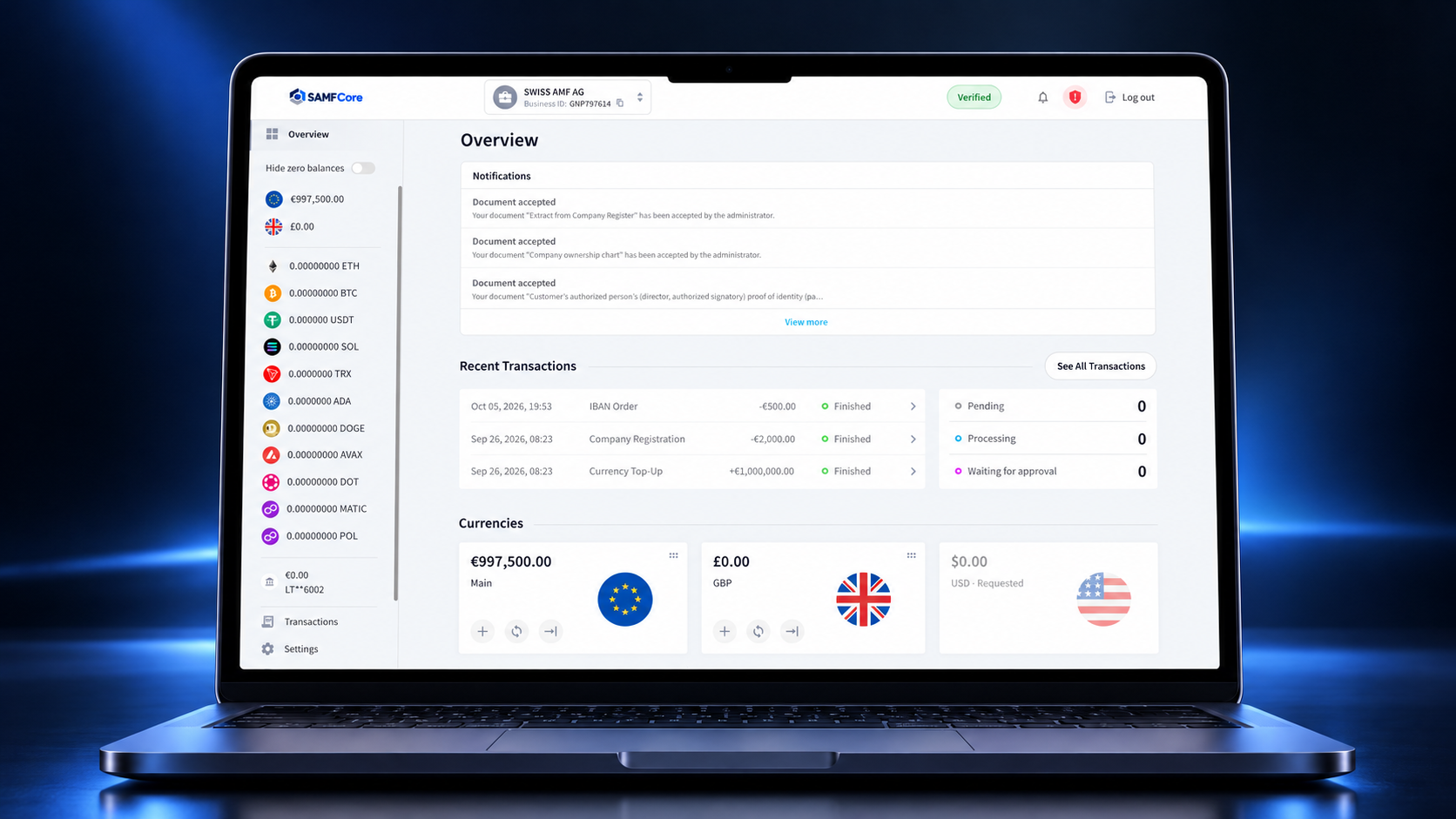
The platform combines individual and corporate onboarding, customer profiles, multi-currency accounts, internal balances, transaction records, transfers, payment workflows, physical and virtual card functions, digital-asset accounts, cryptocurrency exchange, fiat-to-crypto services, compliance workflows, reporting and back-office administration.
Its customer-facing and administrative applications are intended to operate within a common environment.
An important technical distinction is that SAMFCore is more than a visual interface connecting unrelated providers.
The software includes its own internal balance-management and transaction-recording functionality. It can maintain account balances, record financial movements and support transfers between users within its own system.
However, these capabilities should not be confused with a complete authoritative core banking ledger designed to replace every accounting and financial-processing function of a regulated deposit-taking bank.
External banking, settlement, card issuing, custody, identity verification and other regulated or specialist activities continue to depend on appropriately selected service providers.
SAMFCore coordinates the relevant software workflows and presents them within a unified operating environment.
For a payment institution or digital-asset business whose regulated infrastructure is already supplied by banking and specialist partners, that distinction can be an advantage rather than a limitation.
Such an operator may not need another comprehensive core banking engine. It may need better software for connecting and administering the services it already offers.
This is the essential difference: Mambu primarily provides specialised banking and payments infrastructure; SAMFCore provides a broader operating layer for delivering and managing connected financial services.
Neither approach is inherently superior. Their relative value depends on which problem the purchaser needs to solve.
2. SAMFCore and Mambu: The Principal Differences
| Evaluation area | Mambu | SAMFCore |
|---|---|---|
| Primary focus | Core banking, deposits, lending and payments infrastructure | Integrated financial-services operations and customer delivery |
| Banking ledger | Established banking accounting and financial-product processing | Internal balances and transaction records; not a complete substitute for an authoritative banking core |
| Customer experience | Configurable banking applications, APIs and ecosystem solutions | Integrated customer-facing and administrative interfaces |
| Payments | Payment processing, connectivity and orchestration | Payment workflows through integrated banking and payment providers |
| Cards | Card APIs, transaction processing and issuing/processing integrations | Customer and administrative card workflows through selected issuing providers |
| Digital assets | Specialist digital-asset services can be integrated | Digital-asset accounts, wallet workflows, crypto exchange and fiat/crypto functionality |
| Deployment model | Managed cloud-native SaaS | Customer-controlled infrastructure options |
| Licensing | Negotiated enterprise service agreements | Published annual and perpetual licence packages |
| Source-code rights | Proprietary managed platform with APIs and configuration capabilities | Full Source Code available under specified perpetual licence packages |
| Usage-based software charges | Contract-dependent; account-related additional usage is described in its AWS Marketplace offering | No SAMFCore per-customer or per-transaction software charges or transaction-revenue share |
| Maintenance | Vendor-managed platform maintenance and updates | Independent maintenance possible with applicable source-code rights |
| Principal advantage | Depth of banking infrastructure and established institutional deployment experience | Functional breadth, commercial flexibility and long-term software control |
The table compares published product and commercial models rather than identical implementation configurations. Individual contracts, integrations and technical capabilities must be verified before procurement.
3. Functional Integration: Where SAMFCore Has a Practical Advantage
Financial institutions rarely operate a single financial product in isolation.
A modern EMI or fintech business might provide fiat accounts, international transfers, payment cards, currency exchange, cryptocurrency services and customer support.
Each activity may involve specialist external infrastructure.
The resulting technology challenge is not necessarily obtaining these services individually. It is connecting them into a coherent operation.
Consider an illustrative payment institution offering multi-currency accounts, card services and digital-asset exchange.
Its software environment may need to coordinate banking-provider account information, transaction records, card-programme activity, cryptocurrency balances, identity-verification results, compliance reviews and customer communications.
Without an integrated operating layer, the business may need to develop and maintain several separate applications or substantial custom integration logic.
That can introduce duplicated customer records, inconsistent interfaces, additional reconciliation requirements and fragmented operational visibility.
SAMFCore's architecture is intended to address precisely this problem.
Its financial modules share a broader software environment incorporating customer information, balances, transactions, operational controls and administrative functions.
A customer's account activity, payment workflows and digital-asset operations can therefore be presented and administered through a connected interface, subject to the services actually configured.
This can have several practical consequences.
Customer-service teams may obtain a more consolidated view of a customer's activities. Compliance personnel may be able to review related financial information without moving between as many disconnected applications. Customers may encounter a more consistent experience across different financial products.
The potential benefit extends to software development.
Where the necessary functionality already exists within SAMFCore, an operator may avoid independently developing several customer-facing or administrative modules.
Mambu takes a different approach.
Its infrastructure is designed to be composable, allowing institutions to assemble financial products and surrounding applications using APIs, existing integrations and specialised technology partners.
That approach offers considerable flexibility. It also benefits from Mambu's established ecosystem and implementation expertise.
Importantly, Mambu is not simply a collection of APIs without operational interfaces, and its increasingly comprehensive payments technology should not be underestimated.
The distinction concerns how the complete operating environment is assembled.
A bank building a highly customised digital service around a specialist banking engine may prefer Mambu's architecture.
An EMI or digital-asset operator seeking a broad existing financial-services application, with customer and administrative functionality already designed to work together, may find SAMFCore more directly aligned with its requirements.
For businesses seeking to consolidate several financial products, SAMFCore's integrated design is one of its most persuasive functional strengths.
The extent of any implementation savings will depend on which modules and external-provider integrations are available without additional development.
4. Banking, Payments, Cards and Digital Assets
The platforms' functional differences become clearer when examining specific financial services.
Banking accounts and financial processing
Mambu has the stronger proposition where sophisticated deposit administration, lending logic and core banking accounting are required.
Its configurable financial-product infrastructure is a principal reason banks and lenders select the platform.
SAMFCore supports individual and corporate accounts, multi-currency balances, transaction records and internal transfers. It can also manage customer-facing account and payment workflows connected to external banking providers.
For an operator whose banking and safeguarding arrangements are already established, that may provide the functionality needed at the customer-service and operational level.
For an institution seeking to replace its underlying deposit or lending engine, Mambu would ordinarily be the more relevant starting point.
Payments and money movement
Mambu's payments technology represents a significant part of its current offering.
Its platform supports payment connectivity and orchestration, and the company has continued expanding its payment-network relationships.
In September 2026, Mambu and Mastercard announced a collaboration intended to connect Mastercard Move with Mambu's Intelligent Core for cross-border payment services.
This illustrates the company's continuing investment in payments infrastructure.
SAMFCore approaches payments from the perspective of the financial-services operator.
It supports transfer initiation, internal transfers, beneficiary management, transaction workflows and connections to banking and payment providers.
SEPA, SWIFT and other payment capabilities depend on the relevant provider integrations and contractual arrangements.
For operators needing sophisticated payment-rail processing and orchestration, Mambu's dedicated payments infrastructure may be particularly relevant.
For businesses seeking to manage payment activity alongside accounts, cards, digital assets and administration, SAMFCore's unified operating approach presents a different advantage.
Card services
Both platforms support card-related functionality, although the operational roles differ.
Mambu documents card APIs, token-related functionality, authorisation handling and integration with specialist issuing and processing providers.
SAMFCore provides customer-facing and administrative workflows for physical and virtual card programmes through integrated card-issuing partners.
An operator using SAMFCore can therefore incorporate card activity within its broader financial-services application, subject to the supported provider and programme configuration.
Neither platform should be assumed to provide regulated card issuance independently of the relevant issuing arrangements.
Cryptocurrency and digital assets
Digital assets provide one of SAMFCore's clearest areas of differentiation.
The platform has been designed to incorporate cryptocurrency and related financial services alongside conventional account and payment functionality.
Its documented capabilities include digital-asset accounts, wallet workflows, blockchain-address provisioning, cryptocurrency exchange, fiat-to-crypto and crypto-to-fiat workflows, and integration with custody and liquidity providers.
For financial institutions increasingly serving customers across both fiat and digital-asset markets, this breadth can be operationally valuable.
A business may want its customers to hold fiat balances, access cryptocurrency services, exchange currencies, make transfers and manage payment cards through one branded environment.
SAMFCore is structured around such multi-product operations.
Mambu's architecture can connect to specialised digital-asset providers, and its banking infrastructure may be relevant to institutions involved in digital assets.
Nevertheless, native digital-asset operating workflows are not the central focus of Mambu's core banking proposition.
SAMFCore's emphasis on combining traditional financial services and digital-asset functionality therefore represents a meaningful advantage for fintechs, payment institutions and digital-asset businesses serving both markets.
That advantage does not remove the need for suitable custody, banking, liquidity, blockchain and regulatory arrangements.
5. Licensing Economics: A Different Commercial Proposition
Technology procurement is often dominated by implementation costs and immediate functionality.
Yet long-term licensing arrangements can have an equally important effect on a financial institution's economics.
This is an area in which SAMFCore offers a particularly interesting alternative to conventional enterprise software-service models.
Mambu's enterprise service model
Mambu operates principally through negotiated SaaS contracts.
Customers obtain access to the platform and its managed services under commercial arrangements reflecting their chosen capabilities, commitments and usage requirements.
Its AWS Marketplace listing describes contract-based pricing, including additional account-related charges when usage exceeds the quantities covered by the applicable agreement.
That listing should not be interpreted as establishing identical pricing for all Mambu customers.
A definitive assessment requires a customer-specific quotation, including committed volumes, service levels, implementation requirements and applicable additional charges.
The model has advantages.
A managed service can reduce the need for customers to maintain the underlying software themselves, while providing continuing product updates and vendor support.
For some institutions, those benefits justify recurring expenditure.
SAMFCore's published licence options
SAMFCore takes a different commercial approach by publishing its principal licence prices.
Published SAMFCore Licence Prices — October 2026
| Licence package | Published price |
|---|---|
| Annual Licence | €80,000 per year |
| Perpetual Licence | €325,000 one-time |
| Perpetual + Full Source Code | From €620,000 |
| Enterprise Global | €790,000 one-time |
These prices concern software licensing. Implementation, hosting, maintenance, additional development and external-provider services may incur separate costs.
The Enterprise Global package includes perpetual usage rights, Full Source Code, global geographic rights and unlimited white-label brands for one licensed legal entity, as well as Progressive Cutover Migration within the agreed implementation scope.
Other packages are subject to their respective geographic, branding and contractual provisions.
The commercial significance lies in giving the purchaser a choice between recurring licensing and continuing contractual usage rights.
Under the perpetual model, the institution obtains the right to continue using its licensed software without renewing an annual SAMFCore software licence, subject to its agreement.
That changes the financial characteristics of the investment.
The five-year calculation
Consider SAMFCore's annual and standard perpetual licence options over five years.
| Licence option | Year 1 | Cumulative cost after 5 years |
|---|---|---|
| Annual Licence | €80,000 | €400,000 |
| Perpetual Licence | €325,000 | €325,000 |
The difference is €75,000 in base licence expenditure over five years, assuming unchanged annual pricing and excluding all other costs.
After ten years, the annual licence would amount to €800,000 in cumulative base licence fees, compared with the initial €325,000 perpetual licence payment.
These figures are illustrative licensing calculations, not a complete total-cost-of-ownership assessment.
They do not establish that the perpetual package is universally cheaper. The institution may incur additional maintenance, support, enhancement and infrastructure costs, and the packages provide different contractual arrangements.
Nor do they establish that SAMFCore is necessarily less expensive than Mambu, for which a directly comparable enterprise quotation is unavailable.
Nevertheless, the calculations demonstrate the financial importance of perpetual licensing for businesses intending to use a platform for many years.
Software costs that do not rise with transaction volume
Another characteristic of SAMFCore's licensing deserves attention.
According to its published terms, the company does not impose software charges based on the number of end customers or customer transactions, and does not take a percentage of transaction revenue.
This applies across its published licence packages.
For a financial-services operator, the distinction is commercially significant.
Consider a business expanding from a relatively modest customer base to several hundred thousand users while substantially increasing transaction activity.
Under a software contract containing variable customer- or activity-based charges, growth may increase software expenditure.
Under SAMFCore's published model, that growth does not itself trigger additional SAMFCore software licence fees per customer or transaction.
Of course, other operating expenses may increase.
Payment processors, banking partners, card issuers, compliance providers, custodians, infrastructure providers and other third parties may all charge according to usage.
Software capacity, security and support requirements may also grow.
Nevertheless, removing a transaction-linked charge from the primary software licence gives operators greater predictability over that particular expense.
SAMFCore's strongest economic argument is not an unproven claim that it costs less than Mambu in every situation. It is the combination of published pricing, perpetual licensing and the absence of customer- or transaction-based SAMFCore software charges.
For institutions expecting sustained growth, those characteristics warrant serious financial consideration.
6. Full Source Code: The Question of Technology Independence
Financial institutions tend to become increasingly dependent on their software over time.
Customer information, operating procedures, integrations, reporting processes and commercial workflows become closely connected to the chosen platform.
Replacing that infrastructure can be expensive and disruptive.
Consequently, the degree of control an institution retains over its software deserves attention at the procurement stage.
What SAMFCore offers
Under its applicable Full Source Code packages, SAMFCore provides contractual rights to access, modify, maintain and further develop the licensed software.
Customers can use internal engineering teams or appoint external development providers.
This may allow institutions to adapt their software without depending exclusively on Swiss AMF AG for every future modification.
The implications are practical.
An operator may need to introduce a new banking integration, develop a specialised customer interface, modify compliance-related workflows or accommodate changing technical requirements.
With appropriate source-code rights, documentation and engineering resources, those changes may be managed under the institution's own technical direction.
The option to appoint independent developers can also reduce dependency on a particular vendor's maintenance arrangements, development priorities or commercial terms.
These rights are not equivalent to acquiring ownership of the software's underlying intellectual property.
SAMFCore's Full Source Code licences do not automatically confer unrestricted rights to redistribute, sublicense or commercially resell the software.
Those matters remain governed by the applicable agreement.
Nevertheless, a perpetual licence combined with source-code access and independent maintenance rights provides a different degree of operational control from conventional managed SaaS.
Mambu's alternative
Mambu provides extensive configuration capabilities, APIs and tools for building services around its managed banking infrastructure.
Its customers can develop surrounding software and integrations while relying on Mambu to maintain the underlying proprietary platform.
This offers its own advantages.
Institutions can benefit from managed updates, platform development and vendor support without assuming responsibility for maintaining the entire core banking technology stack.
For banks concentrating their internal resources on product development rather than core software maintenance, this arrangement may be preferable.
However, configuration and API access should not be confused with contractual rights to modify the underlying proprietary source code.
Mambu does not publicly advertise a directly equivalent standard perpetual Full Source Code licence.
For some institutions, that distinction will be relatively unimportant.
For others, particularly those with established internal engineering capabilities and a long investment horizon, it could be decisive.
The responsibility that comes with independence
Source-code access is not automatically an advantage unless an organisation can use it effectively.
An institution taking direct responsibility for software maintenance must consider vulnerability remediation, regression testing, dependency management, release processes, developer continuity and compatibility with third-party services.
It must also ensure that any externally supplied components can be maintained and used within the relevant licensing arrangements.
A source-code package is most valuable when accompanied by reproducible build procedures, deployment documentation, suitable technical dependencies and clearly defined contractual rights.
This is a material consideration for purchasers evaluating SAMFCore.
Even with those responsibilities, its source-code licensing model offers an important strategic option.
A company able to manage its own software development can treat its financial-services platform as infrastructure over which it retains considerable direct influence, rather than relying exclusively on the continuing services of its original software supplier.
7. Deployment Flexibility and External Providers
The distinction between managed SaaS and customer-controlled infrastructure extends beyond licensing.
It affects operational resilience, cybersecurity, data governance, development responsibilities and the institution's relationship with infrastructure providers.
Mambu's managed cloud-native model allows customers to concentrate on their financial products while the platform provider maintains the underlying software service.
This can reduce infrastructure-management responsibilities and simplify certain operational arrangements.
SAMFCore offers customer-controlled deployment options across its published licence models.
An institution can select suitable hosting arrangements, subject to the relevant technical and contractual requirements.
For established operators, this may allow greater influence over infrastructure architecture, deployment environments, operational policies and relationships with hosting providers.
SAMFCore also separates its software proposition from the regulated services supplied through external providers.
Banking, payments, cards, custody, identity verification and screening functions can be connected through the platform's integration framework.
This gives operators scope to select service providers according to their jurisdiction, business model and existing commercial relationships.
The approach can be particularly relevant to institutions that already possess banking, payment-processing or custody partnerships.
Rather than necessarily replacing those relationships, the operator can evaluate whether SAMFCore can serve as the common software environment connecting them.
There are practical limits.
Provider independence does not guarantee that every third-party service is immediately compatible. New integrations may require development, testing, certification, contractual onboarding and regulatory approval.
Likewise, customer-controlled deployment does not automatically mean lower cost or better security than a managed cloud service.
The benefit is flexibility rather than an assurance of superior performance.
For institutions with capable technical teams and established provider relationships, however, the combination of deployment choice, integration flexibility and optional source-code rights strengthens SAMFCore's position.
8. User Experience and Operational Administration
Financial software is often assessed according to architecture, processing capacity and contractual terms.
These are essential considerations, but they are not the only ones.
Daily usability affects customer-service efficiency, training requirements, operational error rates and the quality of the customer experience.
SAMFCore places considerable emphasis on integrating financial functions into relatively straightforward customer-facing and administrative interfaces.
Its product design is intended to allow users to move between accounts, transactions, payments, cards and digital assets within a consistent environment.
Operational personnel can access related customer information, administration and compliance workflows through the back-office application.
This design is relevant because broad functionality can become counterproductive when it creates unnecessarily complicated interfaces.
A separate October 2026 review by banking consultant Dr. Kassem Lahham, published by Bright Wealth Banking, reported favourable impressions following hands-on exploration of SAMFCore's sandbox environment.
That assessment highlighted the organisation of the customer and administrative interfaces, their navigation and the way multiple financial functions were presented within one environment.
The observations provide useful qualitative context, although they should not be mistaken for formal usability testing, accessibility certification or evidence of performance under production conditions.
Mambu also provides administrative interfaces and extensive tools for developing customer experiences, while its ecosystem allows institutions to integrate specialist applications.
Accordingly, the relevant issue is not whether either platform possesses an interface.
It is whether the proposed implementation already contains the customer journeys, operational controls and administrative functions the institution needs.
SAMFCore's proposition is strongest where the purchaser wants a broad existing application that can be branded and adapted.
Mambu may be preferable where an institution intends to develop a highly specialised customer experience around a configurable banking engine.
For either platform, a procurement team should evaluate actual workflows rather than relying on screenshots or product descriptions.
9. Implementation, Security and Technical Assurance
A financial-services platform can be commercially attractive while still requiring substantial technical due diligence.
Implementation involves considerably more than installing software.
Data migration, financial reconciliation, provider connectivity, permissions, access controls, security testing, operational continuity and staff training must all be addressed.
Mambu benefits from an established international customer base, published implementation examples and a substantial partner ecosystem.
Its banking infrastructure has been adopted by institutions across numerous markets, giving prospective customers access to a relatively broad body of publicly documented deployment experience.
That is an important procurement advantage.
SAMFCore has a different development history.
According to Swiss AMF AG, development began in 2018, with the platform's principal financial-services functionality established by 2021 and subsequently refined through continued development and operational use.
A historical developer-provided assessment cited in the Bright Wealth Banking review recorded an estimated 7,180 developer-days and an estimated development value of approximately €11.49 million as of January 2024.
Those figures provide an indication of reported development scale, but they are not audited expenditure or a verified market valuation.
The same review also describes substantial historical load-testing exercises involving SAMFCore's cryptocurrency exchange infrastructure in 2021.
The reported exercises included simulated high-concurrency workloads. However, the historical test results were not independently reproduced in that review, and the figures should not be treated as verified benchmarks of SAMFCore's present-day production performance across every module.
For institutional buyers, the relevant evidence would include current load tests, transaction-processing results, resilience testing, system availability records and assessment of the actual proposed deployment.
Legal and contractual assurance
Swiss AMF AG also refers to a Swiss legal opinion addressing intellectual-property ownership and its contractual authority to commercialise SAMFCore through perpetual and Full Source Code licensing.
Such legal analysis is relevant to purchasers contemplating substantial software rights.
An institution needs confidence that its software supplier possesses the authority to grant the contractual rights being offered.
Nevertheless, the opinion's precise scope and conclusions should be examined directly.
Legal analysis of intellectual-property and licensing arrangements does not establish software security, operational resilience or performance.
Compliance and cybersecurity
Both platforms support aspects of operational control, administration and compliance.
SAMFCore documents KYC/KYB workflows, compliance reviews, transaction controls, permissions, reporting and integrations with specialist screening and identity-verification providers.
Mambu offers account administration, permissions, auditing capabilities and integration options for compliance services.
Neither platform should be regarded as automatically compliant with every regulatory requirement simply because relevant software functions exist.
The operating institution must ensure that its licensing, third-party arrangements, configuration and internal controls meet applicable legal and supervisory requirements.
For SAMFCore, a suitable technical assessment should include source-code and dependency review where relevant, penetration testing, access-control evaluation, backup and recovery testing, and verification of provider integrations.
The same principle applies to Mambu, although the division of responsibility will differ under its managed-service model.
Mambu currently has the stronger publicly visible institutional deployment record. SAMFCore counters with an established development history and a commercial model that may provide purchasers with greater contractual and technical control.
These are different forms of assurance, and neither should be confused with the other.
10. Migration and Total Cost of Ownership
Financial-services operators considering a technology replacement must evaluate the complete transition rather than the software licence alone.
Migration can involve customer data, financial records, account balances, transaction histories, payment-provider connections, compliance information and reconciliation processes.
Mambu has experience supporting institutional banking transformations, including approaches that allow organisations to modernise elements of their infrastructure progressively.
Its managed-service model and implementation ecosystem can be advantageous for institutions seeking to reduce internal infrastructure responsibilities.
SAMFCore promotes a Progressive Cutover Migration approach, intended to facilitate staged transitions from existing financial-services software.
The company's Enterprise Global licence includes specified migration services within the agreed implementation scope.
These encompass planning, data-migration support, provider-retention analysis, integration transition, staged user migration and cutover assistance.
The approach is relevant to institutions considering replacement of fragmented financial-services applications while retaining selected external banking and processing relationships.
Nevertheless, migration scope must be established contractually. Complex data extraction, legacy-system dependencies and additional integration development can create costs outside a standard arrangement.
The broader financial comparison should include all material expenditure over the intended operating period.
That includes licensing, infrastructure, integration, maintenance, support, development, cybersecurity, external-provider charges and migration costs.
For SAMFCore, the opportunity to reduce application-development requirements and avoid recurring licence fees may produce favourable long-term economics.
For Mambu, managed operations, existing integration patterns and vendor-supported infrastructure may reduce other categories of expenditure.
Without matching implementation specifications and contractual quotations, neither outcome can be quantified reliably.
The most credible commercial conclusion is therefore narrower but still important: SAMFCore offers licensing and software-control options that can materially change an institution's long-term cost structure.
11. Which Institutions Should Choose Which Platform?
The strongest decision criterion is not the relative size of the vendors. It is the degree of alignment between the product and the institution's actual requirements.
Where Mambu is likely to be the stronger choice
Mambu deserves particular consideration for institutions undertaking core banking modernisation, implementing deposit or lending engines, administering complex financial products, or seeking a mature managed banking and payments infrastructure.
Its established customer base, configurable banking capabilities, payments technology and implementation ecosystem make it a substantial option for these requirements.
Organisations prioritising a managed software-service relationship over direct source-code control may also prefer its model.
A bank seeking a replacement for its authoritative deposit and lending systems should not assume that SAMFCore is an equivalent substitute.
Where SAMFCore may offer greater value
SAMFCore becomes particularly relevant where an institution needs to bring several financial services together within one branded operating environment.
This includes EMIs, payment-service providers, digital-asset businesses, established fintechs and neobank operators that rely on external banking and specialist infrastructure.
Its appeal is strongest when the purchaser wants customer-facing and administrative functionality, fiat and digital-asset workflows, predictable licence expenditure, customer-controlled infrastructure and the option to maintain or develop the software independently.
An institution with substantial transaction volume may also place considerable value on SAMFCore's policy of not charging per-customer or per-transaction software fees.
For operators with the technical resources to use them, perpetual licensing and Full Source Code rights can further strengthen the financial and operational case.
Could the platforms be complementary?
Potentially.
A dedicated banking engine and a broader financial-services operating layer can perform different functions within the same technology architecture.
In principle, an institution might use a specialist core banking platform while employing another system for selected customer-facing and operational activities.
Whether Mambu and SAMFCore can be combined in a specific deployment would require technical and commercial assessment.
Such compatibility should not be presumed to exist as a standard packaged integration.
The broader point is that financial institutions should assess software by architectural role rather than assuming every financial technology platform is intended to perform the same tasks.
12. The Questions That Matter Before Procurement
A credible purchasing decision should be supported by practical demonstrations and detailed contractual analysis.
For Mambu, buyers should assess the precise banking and payment modules included in their proposed package, financial-product configuration, provider integrations, data access, service levels, recurring charges and any additional usage commitments.
They should also distinguish presently available product capabilities from new features or services in limited release.
For SAMFCore, the priority should be confirming the completeness of the required functional modules, the availability of necessary provider integrations, the quality of the customer and administrative workflows, and the exact scope of the licensed deployment.
Where source-code rights are important, purchasers should examine the deliverables, build procedures, dependencies, documentation, maintenance rights and restrictions on commercial exploitation.
Security, resilience, scalability and regulatory suitability require separate verification.
A particularly important exercise for SAMFCore would be to demonstrate the complete journey of an individual or corporate customer across onboarding, account management, payments, cards, digital assets and compliance administration.
That would help establish whether the integrated functionality produces the practical efficiencies suggested by the platform's architecture.
The final commercial evaluation should compare realistic five- and ten-year total costs under matched business assumptions.
A lower initial price does not always produce lower long-term expenditure. Equally, a managed service does not necessarily offer the greatest financial flexibility or technological independence.
The decisive question is which model supports the institution's operational requirements and strategic objectives at an acceptable total cost.
Final Verdict: SAMFCore's Strongest Advantage Lies Beyond the Feature List
Mambu has earned its position as a recognised financial technology provider through substantial investment in core banking infrastructure, lending, deposits, payments and composable architecture.
Its continued development, including the Intelligent Core initiative, demonstrates that the company is extending its proposition beyond traditional banking engines.
For institutions requiring sophisticated banking-product processing and managed infrastructure, it remains a credible and potentially preferable choice.
SAMFCore should not be presented as a universal replacement for those capabilities.
Its competitive strength lies elsewhere.
For financial-services businesses seeking to operate several connected products, SAMFCore offers a combination that is difficult to dismiss: substantial customer-facing functionality, integrated administration, fiat and digital-asset workflows, flexible deployment options, perpetual software licensing and optional Full Source Code.
Its commercial model is particularly noteworthy.
Published licence pricing provides a useful starting point for procurement planning. Perpetual rights offer an alternative to indefinite annual software licence renewals. The absence of SAMFCore per-customer and per-transaction software fees may be especially valuable to operators anticipating significant growth.
Full Source Code licensing creates a further distinction by allowing qualifying institutions to assume greater direct responsibility for the evolution of their software.
The result is a proposition that appeals not only at the product level, but at the level of long-term business strategy.
These advantages are not costless. Operating software independently requires technical resources, proper security arrangements and continuing maintenance. External financial-service providers remain necessary, and the precise benefits of the integrated architecture depend on the completeness of the relevant deployment.
Mambu also has a clear advantage in publicly documented institutional implementations and the maturity of its specialist banking infrastructure.
Those considerations should weigh heavily in any procurement exercise.
Even so, they do not diminish the significance of what SAMFCore offers to a different category of purchaser.
An established EMI, PSP or digital-asset business may have little reason to pay for the capabilities of a specialist core banking engine if its principal requirement is to connect and administer existing financial services more effectively.
For such an institution, the question may be less about the sophistication of the underlying banking engine and more about the efficiency, adaptability and economics of the software through which its customers are served.
That is where SAMFCore can make the stronger case.
My assessment is that SAMFCore deserves serious consideration by established financial-services operators seeking an integrated platform that can support business expansion without creating unnecessary long-term dependence on a single software supplier.
Its appeal is not based on being larger, more established or demonstrably more capable in every category than Mambu.
It rests on a specific and potentially valuable combination of functional integration, contractual flexibility and technology control.
For companies with the appropriate operating model and technical resources, those characteristics may ultimately matter more than the market position of the vendor.
Mambu remains a strong choice for core banking and managed financial infrastructure.
For operators prioritising a broad financial-services environment, particularly where fiat services and digital assets intersect, SAMFCore may offer the more strategically aligned and commercially advantageous solution.
The case is compelling enough to warrant detailed evaluation, including a live product demonstration, technical due diligence and a deployment-specific financial assessment.
For the right institution, that evaluation could reveal advantages extending well beyond the initial software purchase.
Review Methodology and Sources
This comparison considers the companies' publicly described product capabilities, technical documentation, licensing arrangements, commercial models and selected third-party commentary available as of 28 October 2026.
It is a comparative editorial assessment based on published and attributed information. It does not represent a direct hands-on comparison of both platforms, an original source-code audit, an independently conducted penetration test or a verified production-performance benchmark.
Statements concerning SAMFCore's development history, reported historical performance testing and legal documentation rely on the available published accounts and company information. They should be distinguished from independently reproduced technical evidence.
Mambu's negotiated commercial terms were not available for an equivalent implementation, and no claim of a verified like-for-like total-cost advantage is made.
Product features, pricing, licensing rights and deployment availability should be confirmed against current vendor proposals and signed agreements.
Principal reference materials
Mambu
- Official Platform Overview
- Core Banking Capabilities
- Deposits
- Lending
- Payments
- Cards Documentation
- Intelligent Core Announcement — September 2026
- Mambu and Mastercard Collaboration — September 2026
- AWS Marketplace Listing
SAMFCore
Additional reference
Spotted an error? Request a correction · Corrections Policy
Related stories
Experts defer to AI in decision-making, Anthropic study finds
Professional analysts chose options that matched AI assistant's preference 86 percent of the time, research finds.
Al Jazeera ·

‘Emotional intimacy’ from AI chatbots would be banned under Australia’s digital duty of care laws
Labor government under pressure to create social media watchdog as new online safety standards bill passes lower house The federal government wants to ban AI chatbots which seek to create “emotional intimacy” after prime minister Anthony Albanese raised the alarm in a heartfelt speech about children treating these agents as their “best friend”. But Labor is coming under increasing pressure to empower the…
The Guardian ·
Global stock markets rise as investors continue to bet on AI
Asian stock markets rise, following gains on Wall Street.
Al Jazeera ·

A bust-up between mathematicians is fuelling fears that AI could undermine science
AI has made some awesome scientific discoveries. But now, questions are being raised about its accuracy
BBC News ·

'An annoying buzz': The search for stealthier drones
As drone deliveries become more commonplace, their makers are looking for ways to make them quieter.
BBC News ·

Tech Life
We hear from Ondřej Surý, the programmer whose PHP patches helped avert a cyber crisis.
BBC News ·