Analysis · Environment & Climate
Earth’s frozen regions breach a proposed safety boundary—not a collapse deadline
A new cryosphere assessment combines observed changes with committed future losses. Reading those accounts separately is essential to understanding its warning.

Earth’s frozen regions have moved beyond a proposed planetary safe operating space, according to a new assessment. That is a consequential finding about climate risk. It is not evidence that all the world’s ice is approaching a single, imminent collapse.
The distinction begins with the accounting. Published on November 12 in Science, The cryosphere beyond a planetary safe operating space combines changes already apparent with future changes to which the system is assessed to be committed. Those are related, but they are not interchangeable observations. Nor do the assessment’s component estimates describe one common year.
Its strongest contribution is therefore a structured warning: judging the frozen Earth only by what has disappeared so far can understate risk. Its limits matter just as much. A precautionary boundary does not supply a collapse date, and expert agreement cannot turn an uncertain physical threshold into a directly measured one.
Four indicators, not one global ice gauge
The cryosphere encompasses frozen parts of the Earth system, including land ice, sea ice, snow and permafrost. The paper organizes its assessment around four control variables: land ice volume, sea ice area, snow cover area and permafrost temperature.
These indicators measure different properties. Volume describes an amount of ice; area describes geographic coverage; temperature describes a thermal condition. A change in one cannot simply be added to a change in another to produce a meaningful total of “frozen Earth lost.”
Instead, the framework compares each component with a proposed boundary. This makes a diverse system legible without making its parts physically equivalent. It also means readers should resist treating the headline as a uniform diagnosis for every glacier, polar ocean or frozen soil landscape.
The reference is the Holocene, the approximately 11,700-year interval discussed in the Stockholm Resilience Centre’s account of the research. Its role is to anchor precautionary boundaries in conditions associated with that relatively stable climatic period—not to suggest that frozen landscapes were identical everywhere throughout it.
Observed loss and committed loss answer different questions
An observed change asks: how much has the system already changed? A committed change asks: how much further adjustment is implied under the conditions and assumptions being assessed?
That second question matters because large physical systems do not necessarily finish responding when the initial forcing occurs. An ice body can remain substantial while being out of balance with its climate. Its present size is therefore not, by itself, a complete estimate of its future stability.
But “committed” needs careful handling. It should not be read as a synonym for an precisely known loss, on a precisely known timetable, regardless of all future conditions. The meaning depends on the underlying studies: their climate assumptions, time horizons and treatment of reversibility.
The paper distinguishes land ice’s committed changes from components already departing from Holocene-like baselines. Flattening that distinction would convert a mixed assessment of present state and future response into a misleading claim that every assessed loss has already occurred.
The opposite error is also possible. Excluding commitments entirely would make a slow response look reassuring simply because its consequences take time to unfold. Good accounting keeps both categories visible and clearly labelled.
The dates behind the headline do not match
Table 1 provides an important check on how to read the synthesis. It uses 2018 for land ice, 2024 for sea ice and snow, and 2000–2014 model averages for permafrost temperature.
This is not a simultaneous snapshot of the cryosphere in November 2026. It assembles evidence with different temporal coverage—and, for permafrost, explicitly includes a model-based average rather than a single recent observation.
Different periods are not automatically a methodological defect. Global assessments often draw on records that mature at different speeds. But the mismatch limits what can be inferred from their combination. The table cannot, by itself, identify a common crossing year or show that all four components changed together at the same rate.
A single-year estimate and a multiyear average also handle variability differently. Averaging can reduce the influence of unusual years; a recent annual value can retain it. This does not invalidate either approach. It makes the choice of period part of the interpretation, rather than a footnote readers can safely ignore.
A safety boundary is not a measured tipping point
The assessment draws on literature review, expert elicitation and consensus to propose precautionary boundaries. These methods have complementary roles: published studies supply evidence, elicitation brings informed judgment to incomplete questions, and consensus produces an agreed assessment.
None is a direct instrument for locating a physical tipping point.
A tipping point concerns a threshold beyond which a system’s dynamics can drive a qualitatively different response. A safe operating boundary instead asks where a precautionary limit should sit given the evidence and the consequences of error. It can be deliberately more cautious than a best estimate of a physical threshold.
The institutional announcement describes a team of more than 30 scientists led by Bo Su. That breadth matters for a synthesis spanning several research fields, but it is not a statistical sample that yields a confidence interval by headcount. Agreement is most useful when the evidence, assumptions and unresolved disagreements remain inspectable.
Accordingly, the available evidence does not justify endorsing a countdown to sudden global ice collapse. The warning concerns risk beyond a proposed operating space, not a newly discovered planetary stopwatch.
What could change the assessment?
The authors call the assessment provisional and identify substantial observational, reconstruction and modelling uncertainties. These affect different stages of the argument.
Baseline uncertainty concerns the comparison itself. Reconstructing past conditions is harder than reading a modern instrument, and uneven geographic coverage can complicate estimates of a global reference state. Better reconstructions could alter the estimated departure from that baseline.
Observational uncertainty concerns present conditions. Longer, more consistent records and improved coverage could refine the indicators, including how representative a particular year is.
Model uncertainty is especially important for commitments. A plausible mechanism is not enough to establish an exact magnitude or timescale. Confidence should depend on how well models reproduce relevant observations, how results vary across models and whether independent analyses support them. Replication of the synthesis using alternative defensible assumptions would help reveal which conclusions are robust.
The implication is urgency without a false deadline
The practical value of the framework follows from these distinctions. It asks decision-makers to consider both damage already visible and delayed consequences that present measurements may not fully capture. Yet a planetary assessment is not a substitute for regional projections of water availability, coastal exposure or ground stability.
Crossing a proposed boundary also does not make every subsequent outcome identical. The severity and timing of further change remain substantive questions, not details erased by a threshold label.
The most defensible reading is neither reassurance nor catastrophe on a schedule. The assessment argues that the cryosphere no longer fits within its proposed precautionary limits. Understanding that warning requires keeping observations, commitments and judgment separate—even when the headline brings them together.
Sources and References
- Science: “The cryosphere beyond a planetary safe operating space,” November 12, 2026, DOI: 10.1126/science.aef5636. Original paper, available through a Waternet-hosted copy; principal source for indicators, accounting, reference periods and limitations.
- Stockholm Resilience Centre: “Earth’s frozen landscapes have been pushed beyond safe planetary limits,” November 12, 2026. Institutional explanation of the research team and Holocene reference.
- WIRED: “Climate Change Abolishes Ice,” November 12, 2026. Contemporary reporting; supplementary context rather than the technical basis of this analysis.
Spotted an error? Request a correction · Corrections Policy
Related stories
Uganda minister at COP31: 'We need a just transition'
Funding from wealthy countries to help deal with the impacts of climate change hasn't materialized, says Uganda's environment minister. The East African country is hoping oil and carbon credits will help boost finances.
Deutsche Welle ·
‘In our lands the rain is made of bullets’: Palestinian artists look back in anger, melancholy and defiance
IMMA, Dublin From massacre locations painted on to basalt slabs to photocollages of bulldozed airports, artists from across the Levant address their traumatic history In 2006, Simone Fattal painted on to basalt slabs the names of places indelibly associated with massacres in the Levant since 1948: Deir Yassin; Jenin; Qana; Sabra. Through the names, in the same Arabic script, runs a line of poetry by Etel Adnan:…
The Guardian ·
No mention of fossil fuels in latest COP31 draft deal
One of the most fraught debates at the UN climate talks in Turkey has revolved around the future of coal, oil and gas. Now all mention of fossil fuels has been removed from the summit's new draft agreement.
Deutsche Welle ·
What is a stake at the EU-UK summit in Brussels?
Leaders will wrestle with easing Brexit red tape, restoring emissions trading and opening up youth mobility UK politics live – latest updates The EU and UK will hold a long-awaited summit in Brussels on Friday – the second since Brexit – to hammer out the UK’s longer-term relationship with the bloc. It will be attended by the prime minister, Andy Burnham, the head of the European Commission, Ursula von der Leyen,…
The Guardian ·
‘It’s a biohazard’: Native communities in US south-west try to recover after flooding intensified by El Niño
Residents and local groups band together after severe flooding submerged a New Mexico town in toxic water On the night of 23 October, Jimmie Goodman was trying to get some rest when his sister, who was recovering from back surgery and having trouble sleeping, woke him. Authorities in their home town of Shiprock, New Mexico , had warned that the nearby San Juan River was at risk of flooding as unprecedented rain…
The Guardian ·
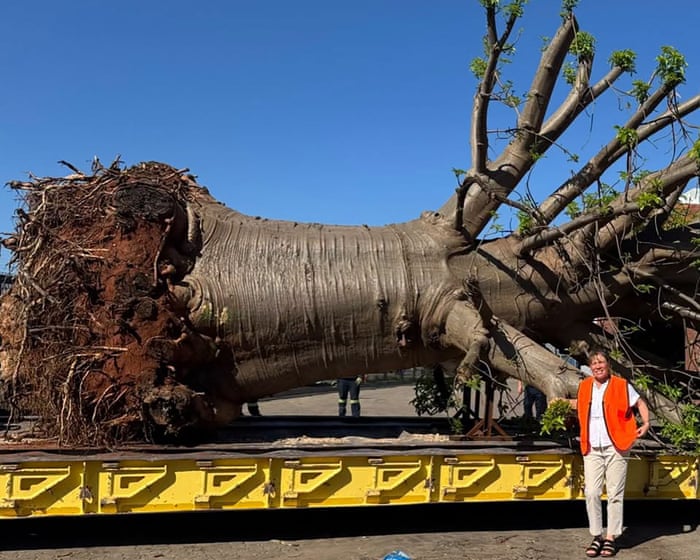
Race to replant five South African baobabs after export blocked
The trees, intended for an unnamed buyer in Georgia, were reportedly dug up without the necessary permits Environmentalists in South Africa are racing to replant five centuries-old baobabs after the 20-tonne trees were dug up by an exporter, who tried to ship them thousands of miles to Georgia. The baobabs arrived at a reserve in Timbavati, in north-eastern South Africa, on Wednesday, where they will be replanted…
The Guardian ·